


Introduction to Flying Robots
In the future, tiny flying robots could be deployed to aid in the search for survivors trapped beneath the rubble after a devastating earthquake. Like real insects, these robots could flit through tight spaces larger robots can’t reach, while simultaneously dodging stationary obstacles and pieces of falling rubble. So far, aerial microrobots have only been able to fly slowly along smooth trajectories, far from the swift, agile flight of real insects — until now.
The Breakthrough
MIT researchers have demonstrated aerial microrobots that can fly with speed and agility that is comparable to their biological counterparts. A collaborative team designed a new AI-based controller for the robotic bug that enabled it to follow gymnastic flight paths, such as executing continuous body flips. With a two-part control scheme that combines high performance with computational efficiency, the robot’s speed and acceleration increased by about 450 percent and 250 percent, respectively, compared to the researchers’ best previous demonstrations.
The Robot’s Capabilities
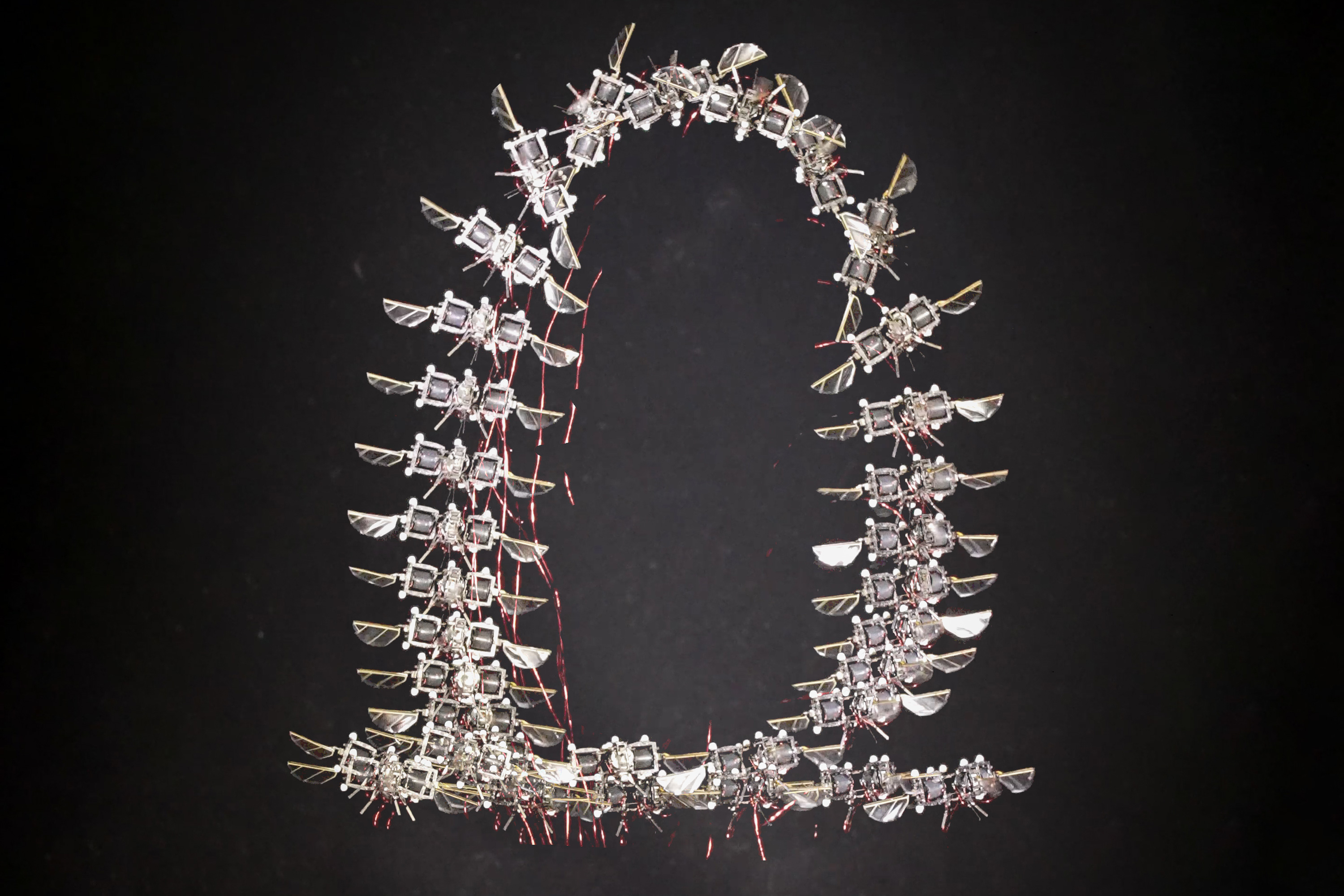
The speedy robot was agile enough to complete 10 consecutive somersaults in 11 seconds, even when wind disturbances threatened to push it off course. This is a significant improvement over previous models, and it brings the robot’s flight performance closer to that of real insects. The robot’s ability to perform complex maneuvers like aerial somersaults and rapid turns makes it an exciting development in the field of robotics.
The AI Controller
The key to the robot’s improved performance is its AI-based controller. The controller uses a dynamic, mathematical model to predict the behavior of the robot and plan the optimal series of actions to safely follow a trajectory. This type of powerful controller is computationally intensive, but it can plan challenging maneuvers like aerial somersaults and rapid turns. The team used a process called imitation learning to train a "policy" based on a deep-learning model, which allows the robot to control its movements in real time.
Insect-like Performance
In their experiments, the two-step approach enabled the insect-scale robot to fly 447 percent faster while exhibiting a 255 percent increase in acceleration. The robot was able to complete 10 somersaults in 11 seconds, and the tiny robot never strayed more than 4 or 5 centimeters off its planned trajectory. This level of performance is comparable to that of real insects, and it opens up new opportunities for multimodal locomotion.
Future Developments
The researchers are planning to add sensors and cameras to the robot, which will allow it to fly outdoors without being attached to a complex motion capture system. They also want to study how onboard sensors could help the robots avoid colliding with one another or coordinate navigation. This will be a major area of future work, and it will help to bring the robot’s performance even closer to that of real insects.
Conclusion
The development of aerial microrobots that can fly with speed and agility comparable to real insects is an exciting breakthrough in the field of robotics. The robot’s AI-based controller and its ability to perform complex maneuvers make it an ideal candidate for search and rescue missions. As the technology continues to improve, we can expect to see these robots being used in a variety of applications, from disaster response to environmental monitoring.
FAQs
Q: What is the main advantage of the new AI-based controller?
A: The main advantage of the new AI-based controller is its ability to combine high performance with computational efficiency, allowing the robot to fly with speed and agility comparable to real insects.
Q: How fast can the robot fly?
A: The robot can fly 447 percent faster than previous models, with a top speed that is comparable to that of real insects.
Q: What is the robot’s acceleration like?
A: The robot’s acceleration is 255 percent better than previous models, allowing it to perform complex maneuvers like aerial somersaults and rapid turns.
Q: What are the potential applications of the robot?
A: The potential applications of the robot include search and rescue missions, environmental monitoring, and disaster response.
Q: How does the robot’s performance compare to that of real insects?
A: The robot’s performance is comparable to that of real insects, with the ability to fly with speed and agility that is similar to that of biological insects.